Now
Last checks before TestFlight
MoreLess
App Store setup, payments and safety reviews are done in code. Next comes TestFlight, and a launch on the @itsevanrico channel.
Everything I’ve built, shipped, dropped and learned since 2025, one dated moment at a time. 56 so far. Open any of them for the full story.
App Store setup, payments and safety reviews are done in code. Next comes TestFlight, and a launch on the @itsevanrico channel.
This one: the timeline, deep dives, writing and the newsletter.
The portfolio moved to evangrico.com and this site became the long version: every dated moment on one timeline, a deep dive per project with demos you can play with, writing, video deep dives and a newsletter. Public for the first time.
Five months in.
By 30 October Biro had 1,147 commits since the first one in May.
Grok joins on a cloud computer of its own.
By the end of October the team had run 1,560 times and finished 141 tasks. Grok, xAI's bot, now works alongside the nine on a cloud computer of its own, taking its own tasks from the same board.
Agent windows move out to VibeEngine.
Heavy agent sessions could take Clear down with them, so the agent windows moved out into VibeEngine, a separate browser just for the agents. Clear went back to being a browser for me.
VibeEngine splits off from Clear.
Heavy agent sessions inside Clear's agent windows could take the whole browser down, so the agents moved into VibeEngine: a browser of their own that runs in the background on the Mac mini.
Its own app, with the old profiles and logins moved across from Clear.
Heavy agent sessions took Clear down with them, so the agents got a browser of their own. It runs in the background on the Mac mini, and the profiles and logins they already had in Clear moved across.
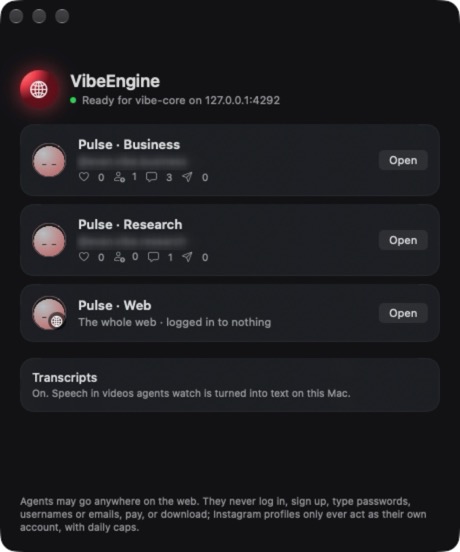
The goal engine, the Today screen, photo proof and hold to complete.
The goal engine that turns who you want to become into a path, the Today screen, photo proof for each step, and the press-and-hold to complete it.
The first beta you can download.
Unlimited profiles, each with its own cookies and logins, threads, history, emoji or photo badge, colour, search engine, backdrop and layout. The glass was rebuilt too: one backdrop for the whole window instead of a blur behind every panel, so there's far less to draw.
Bangs, layouts, split view.
13,000+ !bangs at either end of a query, Sidebar, Compact and Frameless layouts, split view with a divider you drag, hibernating tabs, back to opener, ⌃Tab to the last tab, copy link and force paste, hidden cookie banners and per-site fingerprint noise.
The hard limits live in the browser.
An agent from my Vibe team can browse in a window of its own profile, with its own pointer and a glowing edge. I can take over, hand back or stop it. Clear itself refuses logins, passwords and payments, and locks each agent to one account.
Design system, onboarding screens 1 to 8, sign-in.
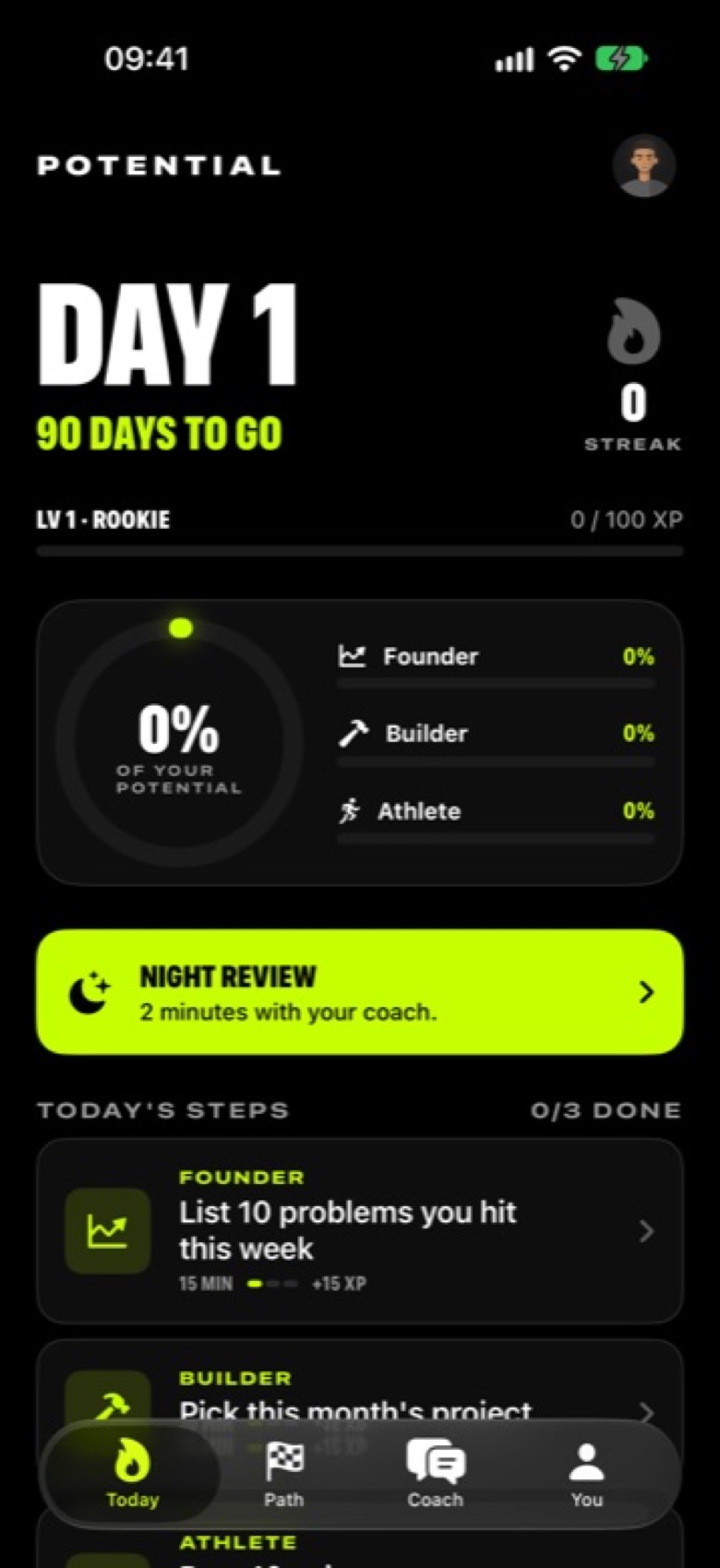
The first day: a design system, the first eight onboarding screens and sign-in.
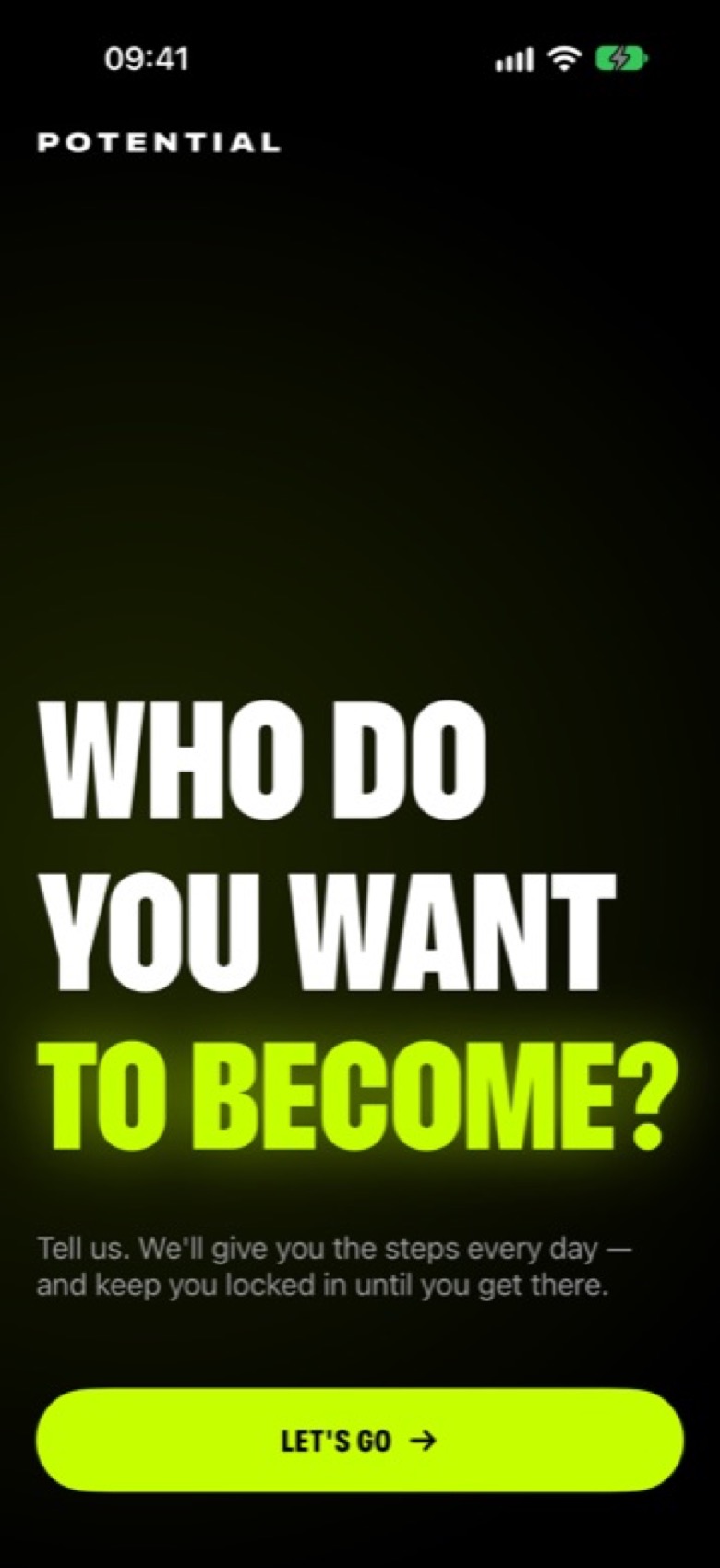
The board, lines and the split-flap clock.
The first build: the departure board, a line for each part of your life, and the giant split-flap countdown.
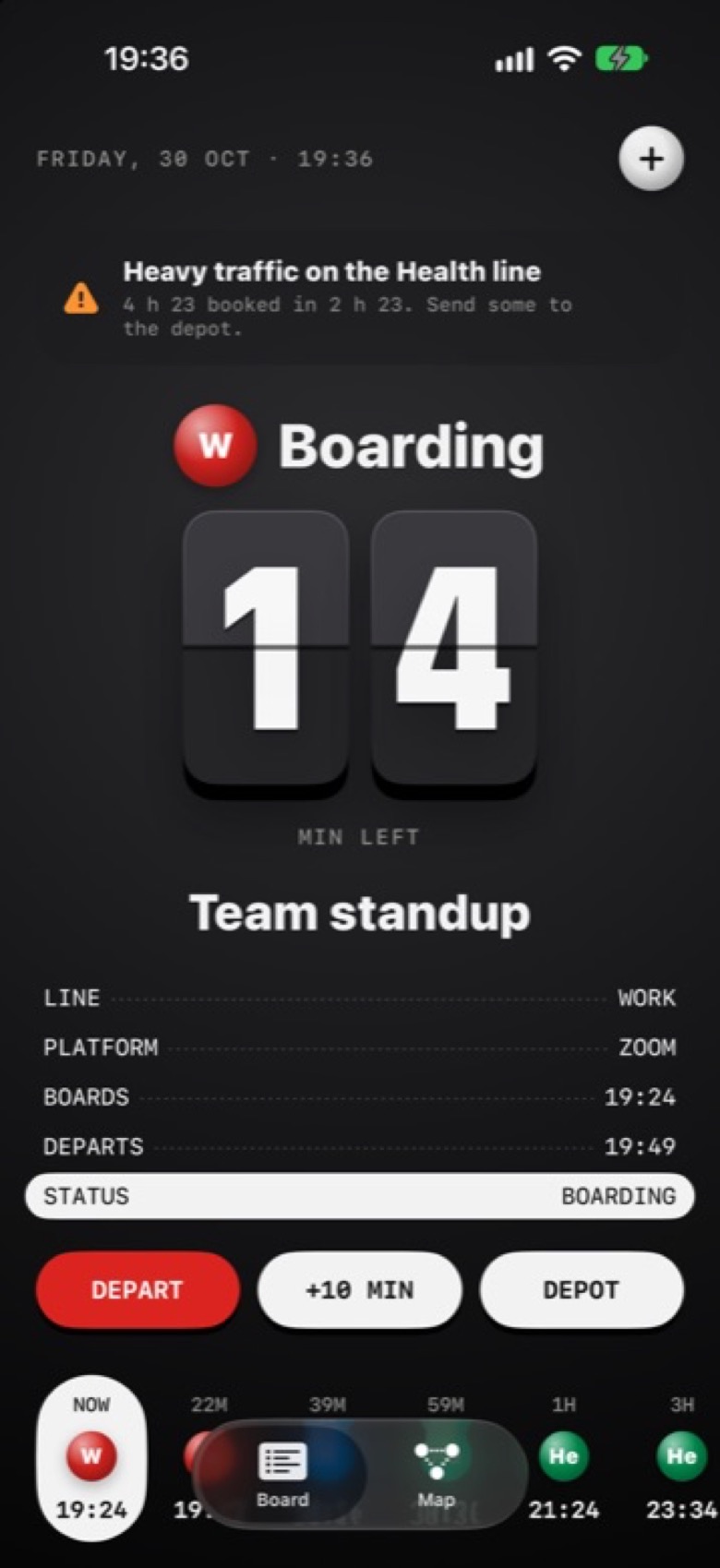
Agents browse in windows of their own, with a glowing edge I can take over.
The first version lived inside Clear: an agent from my Vibe team could browse in a window of its own profile, with its own pointer and a glowing edge. I could take over, hand back or stop it.
On the AppleX site.
AppleSoft went live on the AppleX site, served from the Mac mini with one-time invite links.
Invite-only, served from the Mac mini.
All five parts went up on one site, with a concept demo for each, served from the Mac mini and open only through one-time invite links.
58k lines of TypeScript, 56 screens.
Counted on 9 October: 554 commits since May, about 58,000 lines of TypeScript and 56 screens.
309 runs, 41 of 57 tasks.
In its first three days the team ran 309 times, finished 41 of 57 tasks, wrote 378 messages and 40 files, and asked me for approval 21 times. I said yes 19 times. Across the three apps that make it up there were about 12,000 lines of Swift.
Magic Computer, Media, Wake & Unlock.
Magic Computer puts the Mac mini's screen on my phone, with a trackpad, touch control and a keyboard. Media shows what's really playing. Wake & Unlock types my Mac password only after Face ID, and the password never leaves the phone.
Not yet ready for anyone else.
The computer I build on, the computer I build for, and the small things that make me care so much about both.
Astro, a desk with a filing cabinet, invite-only.
Rebuilt in Astro as a personal desk: each project a world with a chrome object you could spin, looping demos of every feature, and a journey beside each story. It stayed invite-only, with one-time links.
Twelve pull requests from Vibe.
Vibe's first real job: twelve pull requests, including server-verified subscriptions, written by Forge, checked by Sage and merged in one evening.
Talk on the phone, answers on the Mac.
Put the phone on its side and Nova becomes a desk companion: tap him and talk, and he answers out loud. On the Macs his replies appear as little bubbles under the menu bar.
Merged in one evening.
Forge wrote twelve pull requests for Biro, Sage checked every one, and I reviewed and merged them in one evening. In its first three days the team ran 309 times and finished 41 of 57 tasks.
Something you can try.
Each app got a working demo: type a reminder, triage an inbox, or ask the Terminal what went wrong.
VibeWork on the MacBook.
VibeWork started on the MacBook: the team lives in the notch, with an overlay that shows who's working. Team chats for Biro and AppleX gave the agents somewhere to talk to each other.
VibeLite goes on my iPhone the same day.
Before this I had three separate assistants, one each for the Mac, the MacBook and the iPhone. On 6 October I rebuilt them as one team with real jobs: Atlas runs it, Forge codes, Iris designs, Sage checks anything risky, Mint watches money, Hype and Echo do marketing and content, Pulse reads trends, and Nova is my assistant.
Eyes that wander, peeks that waddle in.
The Biro character got sphere eyes that wander and blink, peeks that waddle in, and idle scenes that come every 25 to 45 seconds.
One page for each.
Notes, Music, Reminders, Calendar, Mail, Messages, Photos, Preview, Finder, Freeform and Terminal: one page each for what would finish them.
Swift, WebKit, no Xcode.
A browser written from scratch in Swift on WebKit, built with only Apple's command-line tools.
An ink tear strip that coils and falls.
Opening a pack became a ritual: a card-sized mystery pack, an ink tear strip that coils and falls in front, and a holo platinum pack.
A decision that shaped the app: the Examiner's marking is the gate on the path.
One shell, 116 legacy files gone.
GradeUp became Biro. The cleanup put the whole app in one shell, renamed every folder and removed 116 legacy files.
Ten apps and a shared ledger called CHARGE.
The whole series went on the first version of this site: ten apps, one object each, and CHARGE underneath them all.
Hold the key. Talk. Let go.
A landing page with the install steps and the full pipeline, from the microphone to the paste, on the first version of this site.
Microphone fixed under the hardened runtime, plus an icon and download progress.
The start of this journey...
Next.js, General Sans, a colour world per project.
The first version of this site went up in a day: a type-led portfolio where each project owned one colour, written in MDX with a small studio for writing posts, deployed on Vercel behind a password.
The path rebuilds itself around your weak spots.
The adaptive section engine works end to end. The path now rebuilds itself around whatever you keep dropping marks on, rather than marching everyone through the same order. Next: making that legible to the person using it, which is the harder half.
The tutor hub becomes a scene.
The tutor hub became an animated classroom with the Examiner in it, and asking the tutor now dials a video-call-style session.
Five projects, one person, and the thing nobody tells you about scope.
Guest-first onboarding.
You can do a real lesson before you make an account. The sign-up comes after you've seen what it does, not before.
All 106 sections of GCSE Maths.
A plan for the path, and a map of all 106 sections of GCSE Maths for it to run through.
An encrypted migration kit for the move.
Real flights from OpenSky, with routes when you pick one.
Written into the repo, with a live camera feed behind a minimal greeting.
The first full build.
The first full build: gamified GCSE revision, version 0.0.1.
An Android game, launched from the same shelf.
A day after the beta, Console Pro could launch an Android game (Brawl Stars) next to everything else.
The Mac as a console.
Log out of your Mac and into a console: one shelf for every game, controller first. Within days it was launching Minecraft and Brawl Stars from the same shelf.
Eleven certificates in two days.
Building with the Claude API and Introduction to Model Context Protocol finished the set: eleven in two days.
Claude Code, agent skills, Bedrock, Cowork and all three AI Fluency courses.
The first day of eleven courses from Anthropic Academy. AI Fluency: Framework & Foundations came back 10/10.
Then called GradeUp.
It started as GradeUp: the GCSE revision app I wished I'd had, one that would mark answers the way the exam actually does.
A ten-foot interface for the Mac mini under the TV.
It started as Apple Console Pro: a full-screen, controller-first shell for an M1 Mac mini plugged into a TV.
Can an assistant actually do things on my Mac?
Nothing matches that.
 Pulse
 Forge
 Iris
 Sage
 Mint
 Hype